Complex Diseases
Biological systems that exhibit a tendency towards high genetic instability as part of their adaptation potential define one of our central research areas. Two major classes of such systems — RNA viruses and cancer — share a common feature: they exploit unstable evolutionary dynamics in ways that challenge both our theoretical understanding and our capacity for therapeutic intervention. From an evolutionary and ecological perspective, these systems represent some of the most dramatic examples of how nonlinear dynamics, phase transitions and threshold phenomena shape the fate of living populations.
Viruses and viroids are the simplest forms of replicating structures inhabiting our biosphere. They are the most abundant entity in ecological systems and play a crucial role, from disease spreading to global climate regulation. RNA viruses, in particular, exist as quasispecies — complex populations of closely related but non-identical genomes exploring a vast mutational space. In collaboration with Santiago Elena's laboratory, we study how these populations navigate their fitness landscapes, how they cope with their complexity, and how critical thresholds — error catastrophes — define the boundaries of viable replication. We have shown that replication mode and landscape topology differentially affect mutational load and robustness, and that variability in mutational fitness effects can prevent full lethal transitions in large quasispecies populations. These findings have direct implications for antiviral strategies: pushing a viral population beyond its error threshold could provide an alternative to conventional drug approaches.
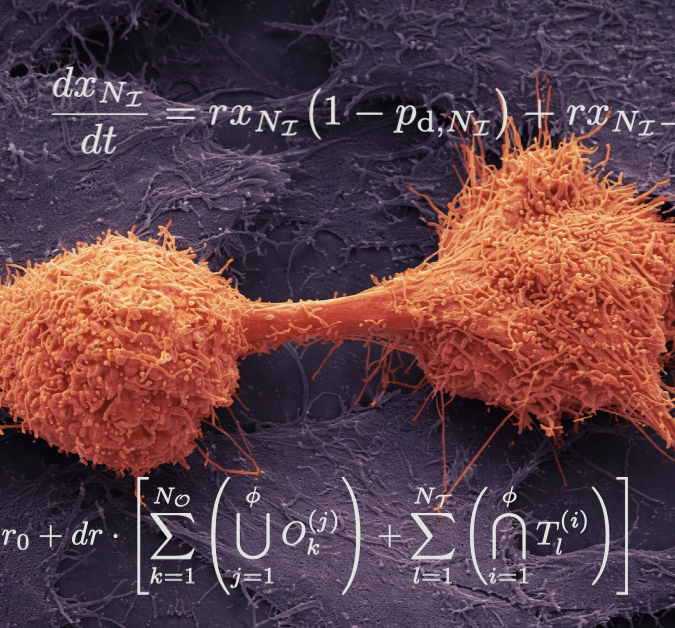
Cancer is the result of a system's breakdown that arises in a cell society when a single cell, due to a mutation or set of mutations, starts to display uncontrolled growth. The cooperation that maintains the integrity of a multicellular organism is disrupted. From an evolutionary point of view, tumour progression is a microevolutionary process in which tumours must overcome selection barriers imposed by the organism. In our lab, we have been studying the enormous levels of genomic instability observable in most advanced tumours — chromosomes appearing duplicated, lost or broken in apparently disorganized patterns. Despite such a degree of aneuploidy, cancer populations are capable of adapting and eventually expanding, killing the host. Are there limits to such instability?
Using mathematical models grounded in dynamical systems theory and statistical physics, we have shown that thresholds to cancer viability are indeed present — phase transitions that separate viable tumour populations from those that collapse under their own mutational burden. Cancer stem cells emerge as the engine of unstable tumour progression, and the propagation of tumour fronts exhibits catastrophic shifts and lethal thresholds that could, in principle, be exploited therapeutically. The Darwinian, ecological nature of cancer demands that we think beyond molecular targets and consider the population-level dynamics of the disease.
More broadly, our interest in complex diseases extends to epidemic spreading on networks, the coevolutionary dynamics of hosts and parasites, and the general problem of how unstable replicating systems maintain themselves at the edge of viability. These systems share deep structural similarities with problems studied in physics — from percolation and critical phenomena to error thresholds in information processing — and we believe that a theoretical physics perspective remains essential for making progress against diseases that have so far resisted conventional approaches.
Tags: Research Topic, complex diseases